
Tools and providers
Part of Trade show marketing procurement: a practical process
Trade show marketing supplier comparison explained for buyers
A practical comparison of the four main trade show marketing supplier types, covering what each does, how they are priced, and the checks to run before signing.
What to take away
Trade show marketing supplier comparison means matching a named company to the job you need done, rather than buying one package that claims to cover everything.
- Freeman, GES, Skyline Exhibits, Nimlok and Unibox design and build stands, quoting per square metre, per project or on a framework agreement.
- Jack Morton, George P. Johnson, MCI and Imagination sell strategy and campaign delivery on monthly retainers.
- Cvent, iCapture and Zuant handle badge scanning and follow-up, priced per device, per event or per record.
- Cognism, Lusha, Apollo.io and ZoomInfo license contact data; the compliance duty sits with you, not them, so check contracts early.
- Fixed-fee projects suit small stands; retainer models suit multi-show programmes.
- Most exhibitors need at least two suppliers, because build and demand generation rarely sit with one firm.
- Quality management certification is a useful first filter when shortlisting exhibit companies.
- Each supplier type carries different risks and pricing models, so compare bids against one written specification.
The four supplier types
Exhibit companies design and build the physical stand. Freeman, GES and Skyline Exhibits work internationally and hold venue relationships at major halls. Nimlok and Unibox sell modular systems you can reuse across a season.
Most builders quote per square metre, per project or on a framework agreement covering several shows. UK bespoke builds typically run £2,000 to £5,000 per square metre, while shell scheme packages sit nearer £100 to £200 per square metre before space rental.
Ask for the project manager's name and how many builds that team has running in the same month as yours.
Agencies such as Jack Morton, George P. Johnson, MCI and Imagination handle strategy, content and campaign delivery. They usually charge a monthly retainer plus media spend, with programme retainers typically starting near £3,000 a month.
A retainer suits exhibitors attending three or more events a year, because briefing costs fall across a longer relationship.
Lead capture suppliers provide badge scanners, forms and follow-up workflows. Cvent sells capture inside its event platform. iCapture prices per device or per event, and Zuant quotes per user or per device. Platform licences often start around £400 a month.
Pricing is often per device, per event or per captured record. Check where the data sits and how quickly you can export it. Ask what happens to the records when the contract ends, because migration fees are rarely quoted up front.
Cognism, Lusha, Apollo.io and ZoomInfo license contact lists for pre-show outreach. Lusha and Apollo.io publish self-serve tiers from about £30 to £100 per user a month, with annual billing cheaper. ZoomInfo and Dun & Bradstreet sell annual contracts, typically five figures a year on committed volume.
Their role is narrow but the compliance burden is not, as the ICO guidance on organisations using marketing services of data brokers sets out, and you remain accountable for how those records are used.
Some suppliers now sell themselves as one-stop partners covering build, campaign and capture. In practice most subcontract two of the three, which adds a margin layer without adding accountability.
Before you shortlist, work through the trade show marketing tools and supplier guide for 2027, which maps supplier categories to budget bands and event sizes. It will save you briefing suppliers that cannot serve your stand footprint.
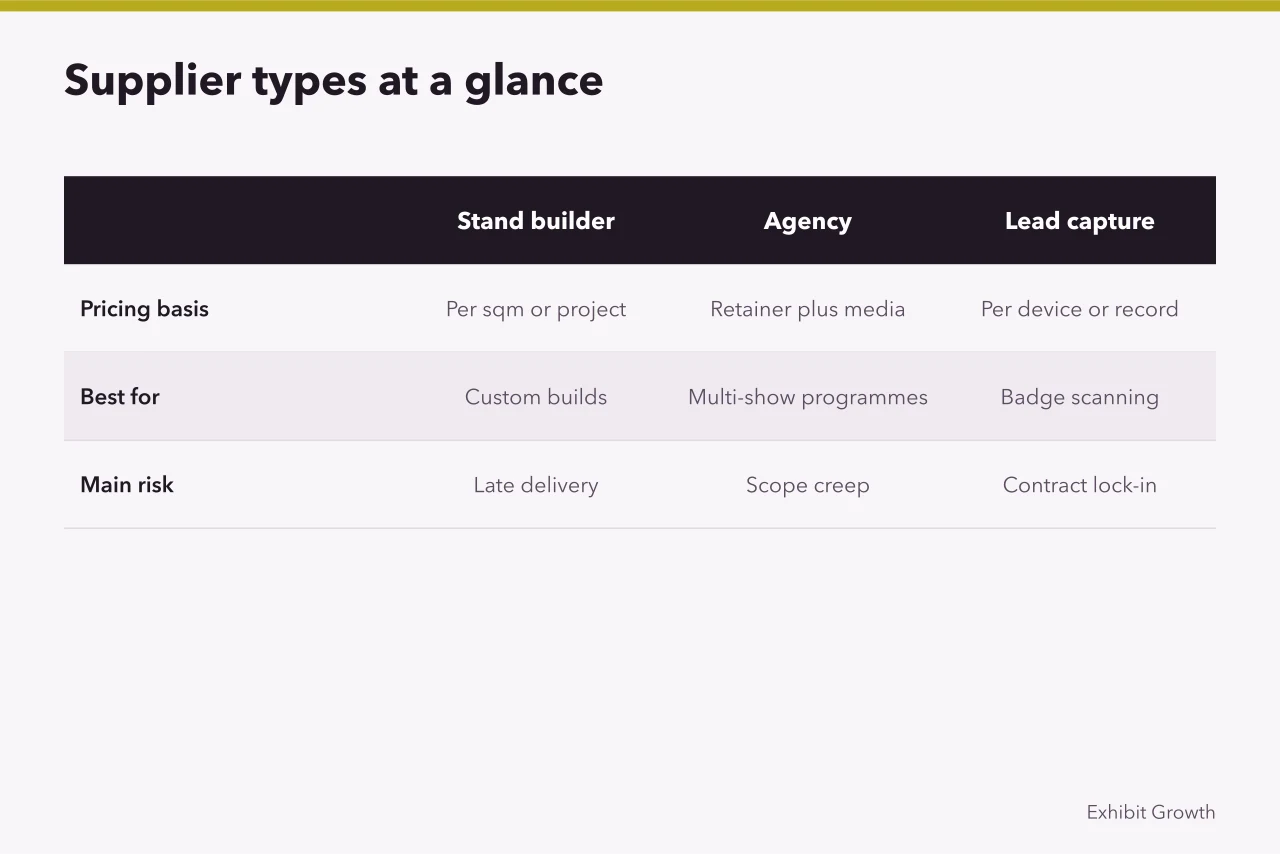
Comparison table
Typical pricing basis
- Stand builders: Freeman, GES
- Per square metre or fixed project fee
- Modular systems: Skyline Exhibits, Nimlok, Unibox
- Per square metre, per kit or hire
- Agencies: Jack Morton, George P. Johnson, MCI, Imagination
- Monthly retainer plus media spend
- Lead capture: Cvent, iCapture, Zuant
- Per device, per event or per record
- Data platforms: Cognism, Lusha, Apollo.io, ZoomInfo
- Per record, per credit or annual licence
Best for
- Stand builders: Freeman, GES
- Physical presence, custom builds
- Modular systems: Skyline Exhibits, Nimlok, Unibox
- Reusable stands across several shows
- Agencies: Jack Morton, George P. Johnson, MCI, Imagination
- Multi-show programmes
- Lead capture: Cvent, iCapture, Zuant
- Badge scanning and follow-up
- Data platforms: Cognism, Lusha, Apollo.io, ZoomInfo
- Pre-show outreach lists
Main risk
- Stand builders: Freeman, GES
- Late delivery, change orders
- Modular systems: Skyline Exhibits, Nimlok, Unibox
- Kit availability, graphic reprints
- Agencies: Jack Morton, George P. Johnson, MCI, Imagination
- Scope creep, slow reporting
- Lead capture: Cvent, iCapture, Zuant
- Data portability, contract lock-in
- Data platforms: Cognism, Lusha, Apollo.io, ZoomInfo
- Consent and accountability
Figures vary by stand size and venue. A team paying £400 a month for a lead capture platform and £12,000 for a shell scheme build is working to a different budget shape from one paying a £3,000 monthly agency retainer.
Ask every bidder to quote against the same written specification, or the totals will not be comparable.
What each type does well
Where stand builders add most value
Builders solve a logistics problem. They hold the venue relationships, manage rigging slots and absorb last-minute changes. Freeman and GES run rigging and electrical teams at many UK venues. Skyline Exhibits, Nimlok and Unibox ship kit stands that two people can assemble.
Choose one with quality management certification, because BSI's quality management standards give you a documented framework to compare bidders against. Ask for the certificate number and check that its scope covers stand building rather than manufacturing alone.
Where agencies and capture tools fit
Agencies add value when your team cannot run outreach alongside the show itself. Jack Morton and George P. Johnson staff on-site teams, while MCI and Imagination often bundle stand design with campaign work.
Lead capture tools add value when follow-up is slow and enquiries go cold within a week. Cvent links scans to registration data, and iCapture and Zuant offer CRM integrations. LinkedIn's lead generation ads can support pre-show targeting, though the cost per lead usually rises in the weeks around a major exhibition.
Questions to ask every supplier
Ask who owns the data, who signs off creative, and what happens if the show moves dates. Request two references from events of a similar size. Confirm whether the quote includes venue fees, electrical work and storage.
Pre-signature supplier checks
- Who owns the data?
- Who signs off creative?
- What if the show moves dates?
- Two references from similar-size events
- Quote includes venue fees, electrical, storage
- Instalments tied to verifiable milestones
Payment terms matter as much as price. A supplier asking for most of the fee before the build starts carries less risk to them than to you. Deposits of 30% to 50% on signature are typical, so tie the balance to milestones you can verify.
Common questions
Should I use one supplier for everything?
Rarely. A single supplier covering build, campaign and data usually subcontracts at least one element, which adds margin without adding control. Two or three specialists with clear handovers is the more common arrangement.
How do I check a supplier before signing?
Run financial and reference checks, then test how they respond to a small request under time pressure. A structured trade show marketing vendor due diligence process covers company records, insurance and data handling in one pass.
Which pricing model is cheapest?
Fixed project fees are cheapest for one-off shows. Retainers become cheaper per event once you attend three or more a year, because briefing and onboarding costs are spread across the programme. Self-serve tiers from Lusha or Apollo.io are the cheapest way to test a contact list, but the consent duty stays with you.
What should the contract cover?
Delivery dates, revision limits, data ownership, cancellation terms and venue compliance. Get the data clauses in writing before any list is supplied, and keep a record of consent for every contact you use.