Tools and providers
Trade show marketing procurement: a practical process
Trade show marketing procurement for UK exhibitors: define the need, write a brief, score proposals, agree contract terms and plan implementation.
What to take away
- Decide first whether you are buying a tool, a service or both, because the scoring criteria and contract terms differ sharply between them.
- Write a brief with a budget range, data rights and exit terms before you approach any supplier, not after the quotes arrive.
- Score providers on evidence you can check, such as named references, insurance cover and a demonstration using your own data.
- Treat implementation and training as part of the purchase price, not an afterthought once the contract is signed.
- Start procurement in the autumn before your first 2027 show if you are building a large stand.
Start with the buying decision, not the vendor list
Most exhibitors begin trade show marketing procurement with a list of companies and work backwards. That produces a shortlist shaped by whoever markets hardest, not by what your stand actually needs.
Start with three questions instead. What must the tool do on the show floor? Who owns the data it produces? What happens if you cancel after the first event?
Write the answers down. They become the spine of your brief and the test you apply to every proposal that lands in your inbox.
Then decide the shape of the buy. Software, services or a managed package each carry different risks in year one, and mixing them in one tender makes the quotes impossible to compare.
Separate tools from providers
A tool is software you operate. A provider is a business that does work for you. Many suppliers sell both, which is where budgets blur.
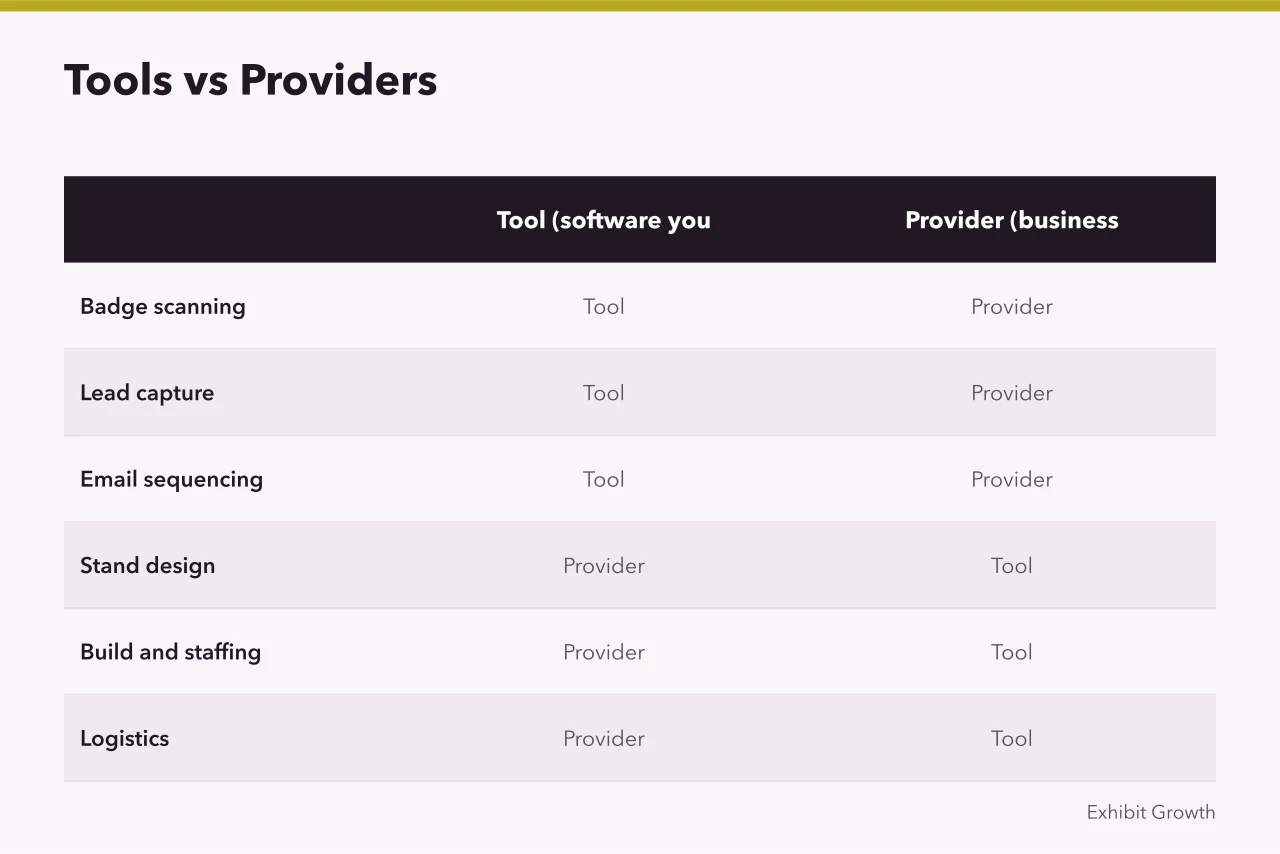
If a supplier insists on bundling everything, ask for the components priced separately. That single request often reveals whether the bundle is genuine value or margin padding.
Before you write the brief, it helps to know which categories exist and what each one is for. A round-up of the best trade show marketing tools in England sets out the main groups of platform and how they differ in practice.
Match spend to the size of your programme
A company doing two shows a year in the Midlands needs a different stack from one running a European calendar with a fresh stand build each time.
Match Stack to Programme Size
Small programme
- Events
- Two a year
- Team
- Four staff
- Stack
- Off-the-shelf
- Licence
- Rarely justified
Large programme
- Events
- Twelve a year
- Team
- Ten staff
- Stack
- CRM event module
- Licence
- Usually justified
For a smaller programme, off-the-shelf lead capture and a shared inbox may be enough. For a larger one, a customer relationship management system with event modules starts to earn its place.
Work backwards from the number of events, staff and leads. If a tool costs more than the leads it produces are worth, it is the wrong tool.
Two shows a year with a team of four rarely justifies an enterprise licence. A twelve-event calendar with ten staff on the stand usually does.
Budget bands are easier to set once you know what the market charges. The trade show marketing costs and budget guide for England breaks spend down into stand, technology, media and staffing lines you can copy into your own plan.
Build the brief before you brief anyone
The brief keeps quotes comparable. Without it, every supplier prices a different imaginary project.
Include objectives for the 2027 season, stand size and location, number of events and staffing numbers. Add data handling requirements, accessibility needs and a budget range.
The budget range matters. Suppliers who refuse to quote against a stated range are usually unwilling to be measured against it.
Circulate the brief internally first. Sales, marketing and operations each hold a requirement that never reaches a supplier conversation unless someone asks for it.
Write down your data and exit terms early
Data is the part exhibitors most often lose in negotiation. Insist on a written answer to who holds scanned lead data, where it is stored and how you get it back.
Under UK GDPR you need a lawful basis for processing visitor data and a clear retention period. The Information Commissioner's Office publishes guidance on lawful bases that applies to lead capture at events, and the same policy covers your shows in Scotland, Wales and Northern Ireland.
Exit terms deserve the same attention. Ask for notice periods, data export formats and any fee charged for leaving. Suppliers who hesitate on export formats are telling you something.
Add a clause covering what happens to your data if the supplier is sold or stops trading mid-season.
Score providers on evidence, not presentation
A scoring sheet turns a subjective shortlist into a defensible decision. Weight the criteria before you see any pitch.
Provider Scoring Weights
- Relevant experience20%
- References15%
- Data handling15%
- Insurance and compliance10%
- Implementation plan20%
- Commercial terms20%
Score providers on evidence
| Criterion | What to check | Suggested weight |
|---|---|---|
| Relevant experience | Comparable stand size and sector | 20% |
| References | Two contactable clients from the last 18 months | 15% |
| Data handling | Written policy and export terms | 15% |
| Insurance and compliance | Public liability and employer cover | 10% |
| Implementation plan | Named staff, dates and training | 20% |
| Commercial terms | Itemised pricing and exit fees | 20% |
Weights are illustrative. Adjust them to match your programme, then hold them fixed across every provider.
A weighted sheet also protects you internally. If two providers finish within a point of each other, that is a signal you need more evidence, not a coin toss.
Checks come before invitations. Running trade show marketing vendor due diligence on filed accounts, insurance and references takes an afternoon and removes most of the risk that a polished pitch cannot hide.
How to run the procurement, step by step
How to run the procurement
- Confirm the internal budget and the person who can sign the contract.
- Write the brief, including data rights and exit terms.
- Longlist eight to twelve providers from trade directories, sector bodies and peer recommendations.
- Screen the longlist against your scoring sheet using public information only.
- Shortlist three or four and send the brief with a fixed question set.
- Ask each shortlisted provider for a live demonstration using your data or a realistic sample.
- Take two references per provider, by phone, with questions agreed in advance.
- Compare written proposals line by line and flag anything priced as a bundle without a breakdown.
- Negotiate data, exit and service levels before price.
- Sign, then schedule implementation and training before the first event.
Step six sorts serious providers from polished ones. A demonstration on your own data exposes whether the tool fits your process or needs expensive customisation.
Procurement in Eight Steps
- Confirm budget and contract signer
- Write brief with data and exit terms
- Longlist eight to twelve providers
- Screen longlist on public information
- Shortlist three or four, send brief
- Ask for live demo on your own data
- Compare proposals line by line
- Sign, then schedule implementation and training
For names beyond your existing network, the find service providers tool maintained by the US Commercial Service lists suppliers by sector and country, which is useful when you are checking an unfamiliar market.
Keep a written record of why each unsuccessful provider was dropped. It protects the decision if a colleague or a board member questions it later.
Include wider event spend in the plan
Event technology is one line among several. Stand space, build, logistics, staffing, travel and marketing usually outweigh software.
Where the Money Goes
- £20,000Example stand cost with no promotion behind it
- Percentage of stand spendBasis for setting the media budget
Paid media is the line most often underestimated. Programmatic display, paid search and paid social each need a budget, a measurement plan and someone to run them.
The Back to Basics Guide to Programmatic from IAB UK explains how programmatic buying works, which helps when a media agency quotes a cost per thousand impressions figure you cannot interpret.
If you run search campaigns around a show, Google's own guide to Google Ads covers campaign setup and conversion tracking, so you can brief an agency or run a small campaign in house.
For B2B audiences, LinkedIn Campaign Manager is where most exhibitors target job titles and industries before a show. Its targeting options line up well with the visitor profiles you would write into a stand brief.
Set the media budget as a percentage of stand spend rather than a round number. A stand costing £20,000 with no promotion behind it is a shop with no signage.
The logistics side most exhibitors underrate
A stand that arrives late costs more than the freight saved. Visibility across your supply chain is what prevents that.
Guidance on supply chain visibility from BSI sets out how to identify risks and dependencies, which matters when your build, graphics and freight sit with three different suppliers.
Ask each supplier for their contingency plan in writing. What happens if the stand is damaged in transit? Who pays for a reprint of graphics? Who is on site if a fitter is ill?
Answers to those questions separate a provider that has done this before from one that has not.
Add the venue's own rules to the brief. Rigging heights, power limits and build windows differ by hall, and a supplier who has worked your venue before will flag them early.
Contracts and service levels
Get service levels in writing with response times. A two-hour response during build week is different from a two-day response.
Contract and Service Level Checks
- Service levels with written response times
- Payment tied to milestones, not signature
- Insurance certificates checked yourself
- Cover confirmed for exhibiting countries
- Subcontracting needs your approval
Payment terms should tie to milestones, not to signature. A deposit, a build-stage payment and a final payment after the show is a normal structure.
Check insurance certificates yourself rather than accepting a verbal assurance. Public liability cover is standard, but limits vary widely. Confirm the cover extends to the countries where you exhibit.
Check whether the supplier can subcontract without your approval. Subcontracted build work is common and often fine, but you should know before the crew arrives on site.
Implementation is where most programmes stall
A tool that nobody uses on the stand produces no leads. Plan training before the event, not during it.
Assign an internal owner for each tool. That person is responsible for setup, user accounts and reporting after the show.
Book a dry run in the office a fortnight before you travel. Scanning a colleague's badge on a live system finds more faults than any manual.
The practical sequence for getting a new system live, from data migration to staff training, is set out in this guide to trade show marketing tool implementation, which is worth reading before you sign anything.
Comparing shortlisted suppliers fairly
Once you have two or three serious proposals, comparison becomes the hard part. Quotes rarely use the same line items.
Rebuild each quote into your own template. Group costs under stand, technology, media, staffing and contingency. The gaps become obvious.
Ask each provider to price the same scope twice: once as a bundle and once as separate components. The difference tells you what the bundle is really worth.
Red flags in a proposal
Vague scope is the most common problem. Phrases like "full event support" mean nothing unless the deliverables are listed with quantities.
Watch for a refusal to name the staff who will work on your account. Account teams change, and you should know who is delivering the work you are paying for.
Then there is bundled pricing that only works if you take everything. Ask for the standalone price of each component; if it does not exist, the bundle is the product.
A method for scoring all of this, including how to weight non-price factors, sits in this guide to trade show marketing supplier comparison, which is useful once the proposals are on the table.
Managing the relationship after the show
The post-show period is where value is won or lost. Leads need to reach your customer relationship management system within days, while the conversation is fresh.
Agree a reporting format before the event. What metrics will you see, in what format, and when?
Hold a debrief with each supplier within a month. Cover what worked, what did not and what changes for the next show. That debrief is also the moment to renegotiate terms for 2027.
Pay the final invoice only after the debrief. It is the last piece of influence you hold over delivery.
Common questions
How many providers should I shortlist?
Three or four is usually enough to compare properly without drowning in proposals. Fewer gives you no real comparison, and more rarely changes the outcome.
Should I buy one tool that does everything?
Only if it fits your process without heavy customisation. All-in-one platforms often excel at one function and underperform elsewhere, so test each module you intend to use before committing.
What should I ask for in the contract?
Data ownership and export terms, service levels with response times, milestone-based payments and a clear notice period. Get all four in writing before signature.
When should I start for the 2027 season?
For large stands, begin procurement in the autumn before your first show, leaving time for design, build and training. For smaller programmes, three to four months is usually workable.
In this guide
- Why trade show marketing software selection should start with the data flowA practical guide to choosing trade show marketing software, covering requirements, procurement checks, data rules and a checklist for comparing vendors.
- Trade show marketing tools and supplier routesTrade show marketing tools and supplier routes for UK exhibitors, covering planning, sourcing, freight, promotion, lead capture and follow-up.
- Trade show marketing supplier comparison explained for buyersA practical comparison of the four main trade show marketing supplier types, covering what each does, how they are priced, and the checks to run before signing.
- Vendor due diligence protects your trade show marketing budgetA practical checklist for trade show marketing vendor due diligence, covering risk, data, claims and contracts, plus a rubric to score exhibit suppliers.
- When to phase trade show marketing tool implementationA stage-by-stage guide to phasing trade show marketing tool implementation, with a before and after table, data protection steps and questions to ask.