Rules and ethics
Belfast exhibitors and Irish Sea customs after the Windsor Framework
Trade show marketing from Belfast now runs through the Windsor Framework, ATA Carnets and customs declarations for stands and samples crossing the Irish Sea.
What to take away
- Trade show marketing from Belfast now runs through the Windsor Framework, so plan customs paperwork before your stand leaves the yard.
- Great Britain to Northern Ireland movements use the green lane for goods staying in Northern Ireland, and the red lane when goods continue to Ireland or the EU.
- An ATA Carnet covers temporary admission for stands and samples, but only if the goods return unchanged.
- Northern Ireland and Ireland trade stays inside the EU single market for goods, so no customs declaration is needed on that leg.
- VAT and evidence rules differ for stand movements.
What the Windsor Framework changes for Belfast exhibitors
The Windsor Framework replaced the old Northern Ireland Protocol and created two routes for goods entering Northern Ireland from Great Britain. Goods that will stay in Northern Ireland use the green lane, with minimal checks. Goods that will move on to Ireland or the rest of the EU use the red lane and full customs formalities.
Belfast-based exhibitors include Queen's University Belfast, Ulster University, Invest NI, Kainos and Belfast City Council.
Green lane vs red lane
Green lane
- Destination
- Stays in NI
- Checks
- Minimal
- Example
- Returns to Manchester
- Paperwork
- Lighter
Red lane
- Destination
- On to Ireland/EU
- Checks
- Full customs
- Example
- On to Dublin show
- Paperwork
- Full declaration
For exhibitors, the practical effect is that your stand, samples and display stock need a declared destination before they cross the Irish Sea. If you are exhibiting at the ICC Belfast and then shipping the same kit to a Dublin show, you are a red lane movement.
If the kit returns to Manchester after Belfast, you are a green lane movement.
That distinction drives your paperwork, your carrier choice and your lead times. It also affects how you buy trade show marketing services, because a supplier who has only worked on English shows may not know the green and red lane split.
The Framework also keeps Northern Ireland aligned with EU goods rules, so stand materials that touch food, chemicals or electrical safety may need to meet EU standards as well as UK ones. Check this before you build, not after.
For cross-border exhibition participation, international trade data from the Office for National Statistics is a useful starting point when you are sizing a market or justifying a stand budget.
Moving stands and samples from Great Britain to Northern Ireland
A stand is not one item. It is usually a flat pack of frames, panels, counters, lighting trusses, carpet, graphics and a crate of samples. Each category can attract different treatment.
Five steps for Belfast exhibitors
- List every item by description and value
- Decide lanegreen or red
- Book carrier with right authorisations
- Prepare customs and temporary admission documents
- Keep packing list with driver and stand manager
Reusable stand hardware that returns to Great Britain is the simplest case. It is temporary admission goods, not a sale, so duty is not normally due. Samples that you give away or sell are not temporary, and they need their own declaration.
Here is the sequence most Belfast exhibitors follow.
- List every item by description, value and whether it returns.
- Decide the lanegreen if the goods stay in Northern Ireland, red if they continue to Ireland or the EU.
- Book a carrier on an Irish Sea route such as Stena Line's Cairnryan to Belfast or Liverpool to Belfast service. Ask what UK Internal Market Scheme (UKIMS) authorisation it needs from you and whether it can lodge CDS declarations.
- Prepare the customs declaration and the temporary admission document before the vehicle sails.
- Keep a copy of the packing list with the driver and a second copy with your stand manager.
A worked example. A Birmingham stand builder ships six crates to the ICC Belfast for a three-day show, then returns them to Birmingham. The goods stay in Northern Ireland, so the movement is green lane.
The builder files a declaration covering the temporary admission, keeps the return leg evidenced by the carrier's signed proof of delivery, and avoids duty because the goods leave as they arrived.
If the same builder then sends two crates on to Dublin, those two crates are red lane and need a separate declaration. Splitting the consignment early saves a lot of argument later.
Supply chain visibility matters here. BSI's guidance on supply chain visibility is written for exactly this problem: knowing where goods are and what status they hold at each border.
Customs steps and declarations for exhibition goods
Customs declarations for exhibition goods are not optional, even when no duty is payable. HMRC wants to see the goods described, valued and accounted for. The declaration is what makes temporary admission work. Declarations go through the Customs Declaration Service (CDS).
Three documents for customs
- Commercial or proforma invoice showing value
- Packing list matching crates to items
- Transport document showing movement and return leg
You will normally need a commodity code, an origin statement, a value and a stated use. For stand hardware, the stated use is exhibition or display. For samples, the stated use is promotional, and if they will be consumed or given away, that changes the declaration.
For example, aluminium display frames often fall under 7610 90 90, and printed brochures often fall under 4911 10 00. Check the current UK Trade Tariff for your exact goods.
Three documents do most of the work:
Customs steps and declarations
- A commercial invoice or proforma invoice showing value.
- A packing list that matches the crates to the items.
- A transport document showing the movement and the return leg.
Keep the descriptions plain. A crate labelled "marketing materials" invites questions. A crate labelled "12 aluminium display frames, 4 LED spotlights, 200 printed brochures" does not.
If you are unsure whether your supplier is set up for this, the trade show marketing market entry checklist is a sensible way to test demand and paperwork before you commit to a Belfast or Dublin show.
Declarations also interact with your contracts. If the carrier or the venue is liable for a failed declaration, that should be written down. Our piece on trade show marketing commercial contracts explains how to allocate that risk.
ATA Carnet use for temporary admission
An ATA Carnet is an international customs document that lets goods enter a country temporarily without paying duty or tax. It is widely used for exhibition goods, professional equipment and commercial samples.
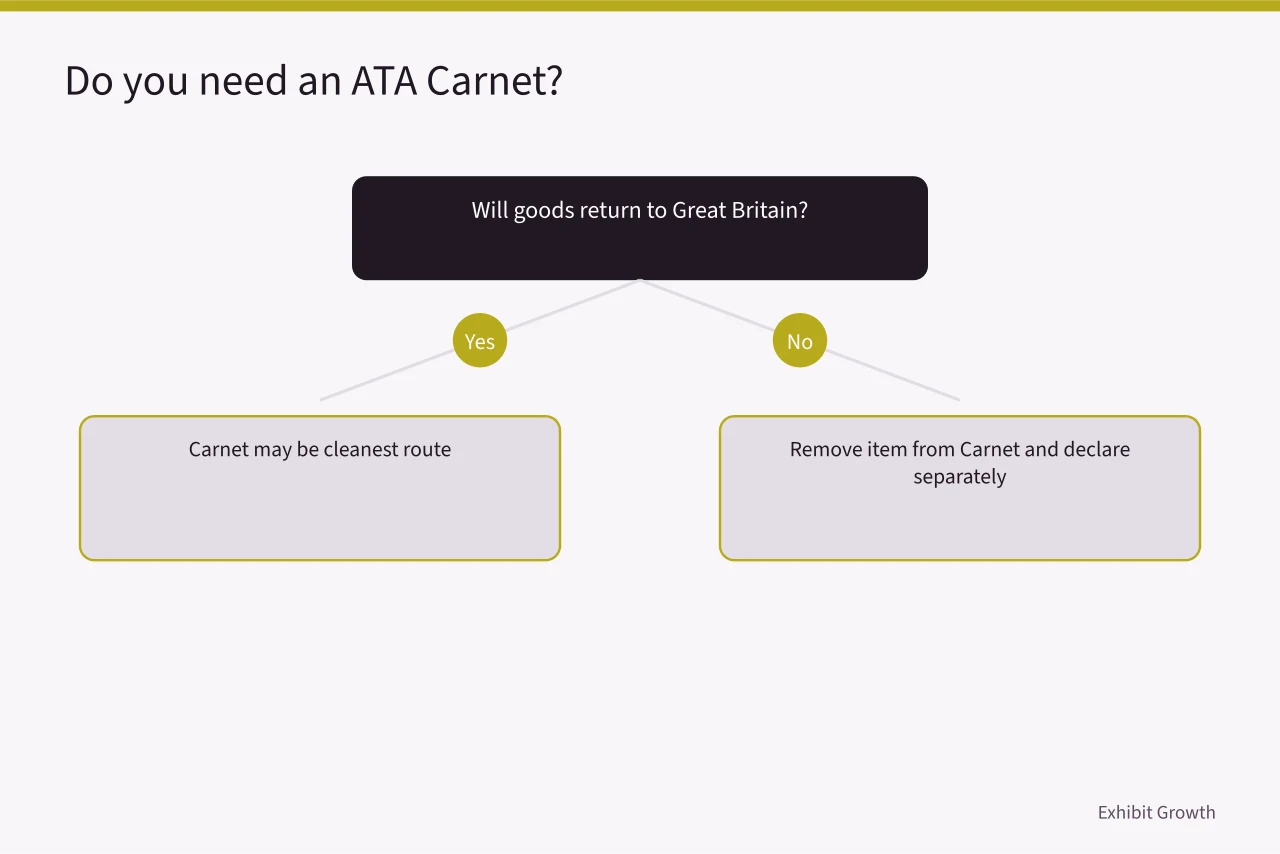
For Belfast exhibitors, a Carnet is often the cleanest route for stand hardware that returns to Great Britain. It covers temporary admission, which is the customs procedure that allows goods to be imported for a set period and re-exported unchanged.
A Carnet is not a free pass. The goods must return within the validity period, usually twelve months, and they must come back in the same state. If you sell a sample or give it away, that item must be removed from the Carnet and declared separately.
In the UK, ATA Carnets are issued by the London Chamber of Commerce and Industry (LCCI). LCCI charges a service fee, typically from around £250 plus VAT, and normally asks for a guarantee or deposit of typically 30 per cent to 40 per cent of the declared goods value. The guarantee is refundable if the Carnet is discharged correctly.
If your goods are moving from Great Britain to Northern Ireland only, and they stay there, a Carnet may be unnecessary because the green lane is lighter touch. If your goods continue to Ireland or the EU, a Carnet becomes more useful because it covers multiple countries in one document.
Whichever route you choose, the Carnet or the declaration must match the packing list. Mismatches are the most common cause of delays at the port.
Moving goods between Northern Ireland and Ireland
Northern Ireland and Ireland trade in goods sits inside the EU single market rules for goods. That means a movement from Belfast to Dublin does not need a customs declaration, because there is no customs border between Northern Ireland and Ireland for goods.
This is the part that surprises exhibitors who have only worked on Great Britain to Northern Ireland movements. The Belfast to Dublin leg is simpler than the Liverpool to Belfast leg.
There are still practical points. You need to show the origin of the goods if you are claiming preference, and you need to keep records of what moved and when. Sanitary and phytosanitary rules apply to certain goods, though most stand hardware and printed samples are unaffected.
If your stand is built in Great Britain, shipped to Belfast, used at a show, then trucked to Dublin, you have two separate movements with two different rule sets. Treat them as two jobs, not one.
For exhibitors expanding into Ireland, export solutions from trade.gov are a useful reference for structuring the commercial side of that expansion.
Cross-border exhibition logistics also depends on the carrier. A carrier that runs the Belfast to Dublin route daily will know the paperwork. A carrier that treats it as a one-off will not.
VAT and evidence for cross-border stand movements
VAT on exhibition services is where Belfast exhibitors lose money quietly. The rules differ depending on whether you are buying stand build services, transport, or venue services, and where the supplier is based.
Evidence HMRC expects
- Carrier documents
- Port records
- Signed delivery notes
- Carnet or declaration matching movement
For services supplied to a business in Northern Ireland by a supplier in Great Britain, the reverse charge can apply. You account for the VAT yourself rather than paying it to the supplier. That changes your cash flow and your records.
For goods, the position depends on whether they are sold, hired or returned. Temporary admission goods that return are not a supply for VAT purposes, but you still need evidence of the return.
HMRC expects commercial evidence, not a note in a diary. Good evidence includes carrier documents, port records, signed delivery notes and the Carnet or declaration that matches the movement. Keep these for the statutory period.
If your stand is hired rather than bought, the hire agreement should set out who carries the VAT liability and where the supply takes place. Our article on trade show marketing hidden costs covers the charges that often appear after the quote.
For risk planning around late paperwork or a failed declaration, the trade show marketing risk scenarios piece sets out the likely failure points.
Planning lead times for Belfast trade show marketing
Belfast shows at the ICC Belfast and other venues reward early planning. Customs paperwork is not a same-week task, and carriers on the Irish Sea run to schedules that fill up around show season.
Eight to twelve week lead time
- 8-12 weeks beforeStart planning and paperwork
- Before showFinalise goods list and lane decision
- Before showApply for Carnet if needed
- Before showBook carrier with authorisations
- Before showCheck declaration against packing list
- After showEvidence and file return leg
- Before showConfirm VAT treatment with accountant
A typical working timeline for a stand that crosses the Irish Sea is below. It gives time for the declaration, the Carnet if needed, the carrier booking and the return leg.
| When | Step |
|---|---|
| 12 to 10 weeks before the show | Finalise the goods list with values and return status. |
| 10 to 8 weeks before the show | Decide the lane: green or red. |
| 8 to 6 weeks before the show | Apply for a Carnet if the goods continue beyond Northern Ireland. |
| 6 to 4 weeks before the show | Book a carrier on an Irish Sea route and confirm UKIMS and CDS arrangements. |
| 4 to 2 weeks before the show | Check the declaration or Carnet against the packing list. |
| After the show | File the return leg evidence. |
| Before the show | Confirm VAT treatment with your accountant. |
If you are sourcing exhibit and trade-show marketing service providers, check that they have moved goods across the Irish Sea before. Find Service Providers is a practical directory for that search.
Lead times also depend on the show organiser's build schedule. Some Belfast venues allow a single build day, which leaves no room for a customs delay. If your paperwork is not ready, you may not get a second slot.