

Operations
Part of Running trade show marketing operations without last minute chaos
Who signs off a trade show marketing quality checklist and how to score it
How to own, run and score a trade show marketing quality checklist, with a red amber green rubric, sign-off rules and follow-up tests for exhibitors.
What to take away
- Decide who signs off the stand, the claims and the follow-up before you score anything.
- Score each item red, amber or green, and treat a red as a blocker.
- Keep the list short enough to finish in one sitting, with a named person and a date per line.
- Record evidence for every green, so a challenged claim can be answered.
- Re-run the checklist after any change to the stand, the offer or the data.
Who owns the quality checklist?
Start with ownership, not paperwork. One person should hold the master version and have the authority to stop a stand going live. That is usually the marketing lead, with the operations manager keeping the on-site copy.
Who can stop the stand?
Can the owner sign off on build day?
Marketing lead signs the list
Deputy signs or refuses
Name a deputy as well. If the owner is travelling or unwell on build day, someone else still has to be able to sign the list or refuse to.
The trade show marketing operations and delivery guide for 2027 sets out how that ownership sits alongside build, logistics and staffing, so read it before you split responsibilities.
If nobody can say no, the checklist becomes a tick-box exercise.
What should the checklist cover?
Group checks by the moment they are used: pre-contract, pre-build, pre-show and post-show. Each item needs a pass condition, not a vague instruction.
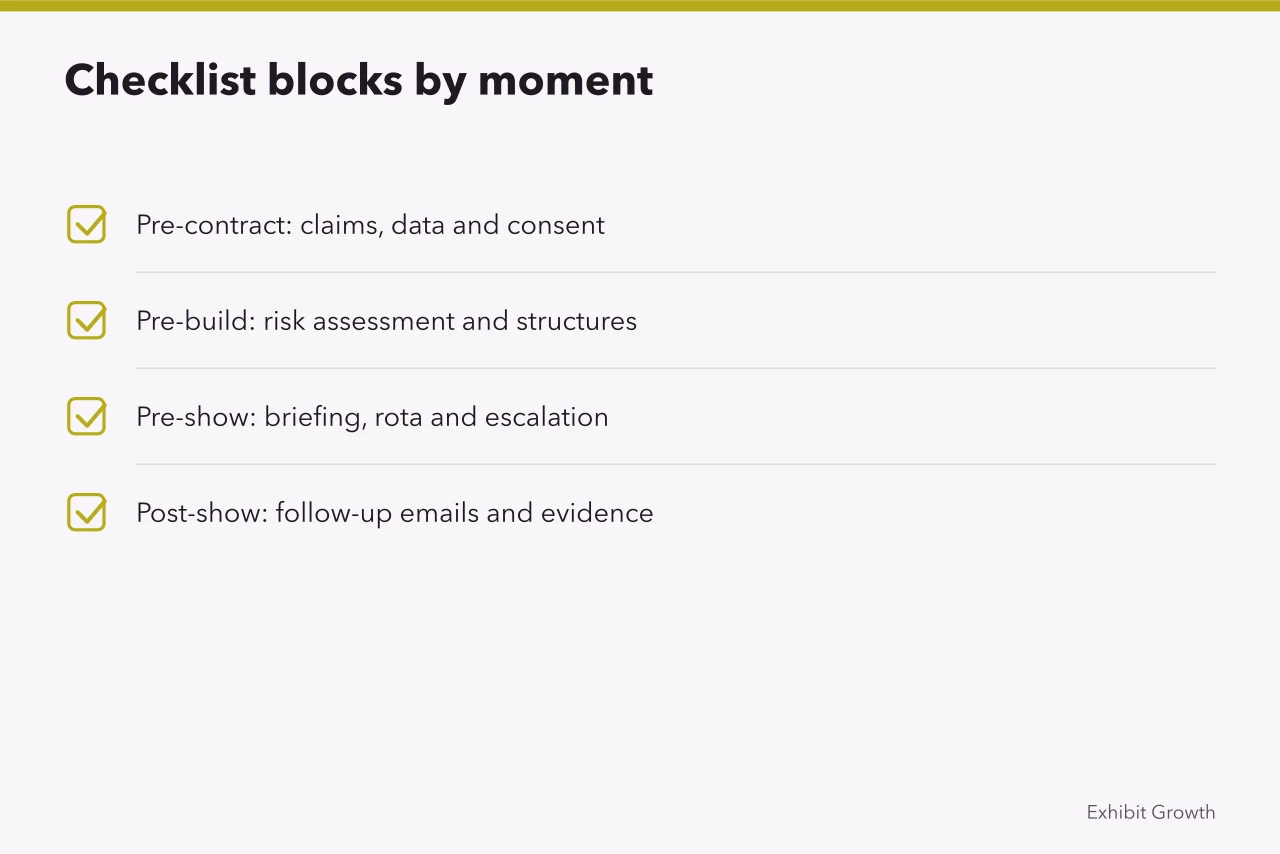
Health and safety sits above everything else. The Health and Safety Executive's guidance on managing event safety covers risk assessment, crowds and temporary structures. It applies to trade shows as much as to any other public event.
Commercial claims come next. Every figure on a panel, slide or email should trace to a source or be labelled illustrative, such as a team paying £400 a month for a stand package.
Data and consent form the third block. If you scan badges or run a competition, check what the visitor agreed to and how long you may keep it.
People and follow-up close the list. Confirm that every stand team member has been briefed on the offer, knows where to escalate a complaint, and understands which enquiry route triggers which email.
How do you score each item?
Use a three-point rubric every time. Green means evidence exists and the owner has signed. Amber means done but unverified. Red means missing or wrong.
| Area | Check | Green | Amber | Red |
|---|---|---|---|---|
| Stand | Risk assessment reviewed and dated | Signed by site lead | Draft only | Not started |
| Claims | Every figure traced or labelled illustrative | Source logged | Source claimed, not filed | No source |
| Data | Consent wording matches actual use | Approved wording | Wording drafted | No wording |
| People | Briefed, trained, rota confirmed | All shifts covered | Gaps flagged | No rota |
| Follow-up | Email sequence tested and compliant | Tested end to end | Built, untested | Not built |
Two reds in one area should stop the sign-off meeting. One red can proceed only with a written fix date and a named owner.
Score the same items at every stage gate rather than rewriting the list each time. Comparing scores across gates shows whether quality is improving or drifting.
How do you test the follow-up?
Follow-up is where most quality failures hide, because it happens after the adrenaline has gone. Send a live test through the whole sequence, including the unsubscribe link and the reply address.
The Data & Marketing Association's analysis of award-winning email campaigns shows how measurement and creative choices are judged together, which is a useful benchmark for your own sequence.
Check that the first email arrives within the window you promised on the stand. If the promise was 24 hours, test a real send.
Before doors open, run a trade show marketing launch review in England so the follow-up, the stand and the briefing are checked as one system.
What evidence should you keep?
Keep one folder per show with the signed checklist, the risk assessment, the consent wording and the source log for every claim. Store it where the team can reach it.
Agree a retention period for that folder before the show, not after. A folder nobody can find six months later is the same as no evidence at all.
Market context helps you set realistic targets. The Office for National Statistics publishes UK business statistics that are useful for sizing the audience you are chasing and sanity-checking attendance assumptions.
Common questions
How long should a quality checklist be?
Long enough to cover the stand, claims, data, people and follow-up, and short enough to complete in one working session. If it runs past two pages, split it by stage rather than deleting checks.
Who signs off the checklist?
The marketing lead usually owns the master version, with the operations manager holding the on-site copy. One named person must be able to stop the stand going live.
When should the checklist be run?
Run it at each stage gate: before signing with a supplier, before the build, before doors open and after the first follow-up send. Re-run it after any change to the offer or the stand.