
Audience research
How do you research a trade show marketing audience?
How to research a trade show marketing audience in England: desk data, interviews, surveys, buyer personas and briefs that exhibit suppliers can build from.
What to take away
- The Office for National Statistics publishes leisure and tourism data, including the UK Tourism Satellite Account, which is a defensible starting point for sizing a UK audience before you spend on stand space. Start there rather than with a supplier's own footfall claim.
- Research pays when it changes a decisionwhich show to book, what to put on the stand, or who staffs it.
- Mix methods by cost. Desk data sets the size of the prize, interviews explain motives, surveys size the pattern, and personas turn all three into a brief an exhibit company can build from.
- Advertising rules still bite inside an exhibition hall. The ASA and CAP publish research on advertising issues and audience impact, and that work informs how claims on stand graphics should be framed.
- Write down what you assumed and what you found. The gap between the two is the most useful page in the file when the next show budget is agreed.
Why audience research comes first
Most exhibitors book space before they know who walks the aisles. That order is backwards.
Research Before You Book
- Write the decision at the top
- Choose the show
- Design the stand
- Set the message
- Pick the people to send
Research is not a report for its own sake. Get it wrong and every later cost, from stand design to follow-up, is spent in the wrong direction.
For an England-based team, the practical question is simple: what can we know before we commit money? The answer is more than most teams assume, and it rarely requires a large budget.
Start with the decision you are trying to make. A team choosing between two regional shows needs different evidence from a team that has already booked and is deciding what to display.
Write the decision at the top of the page.
What the public data tells you
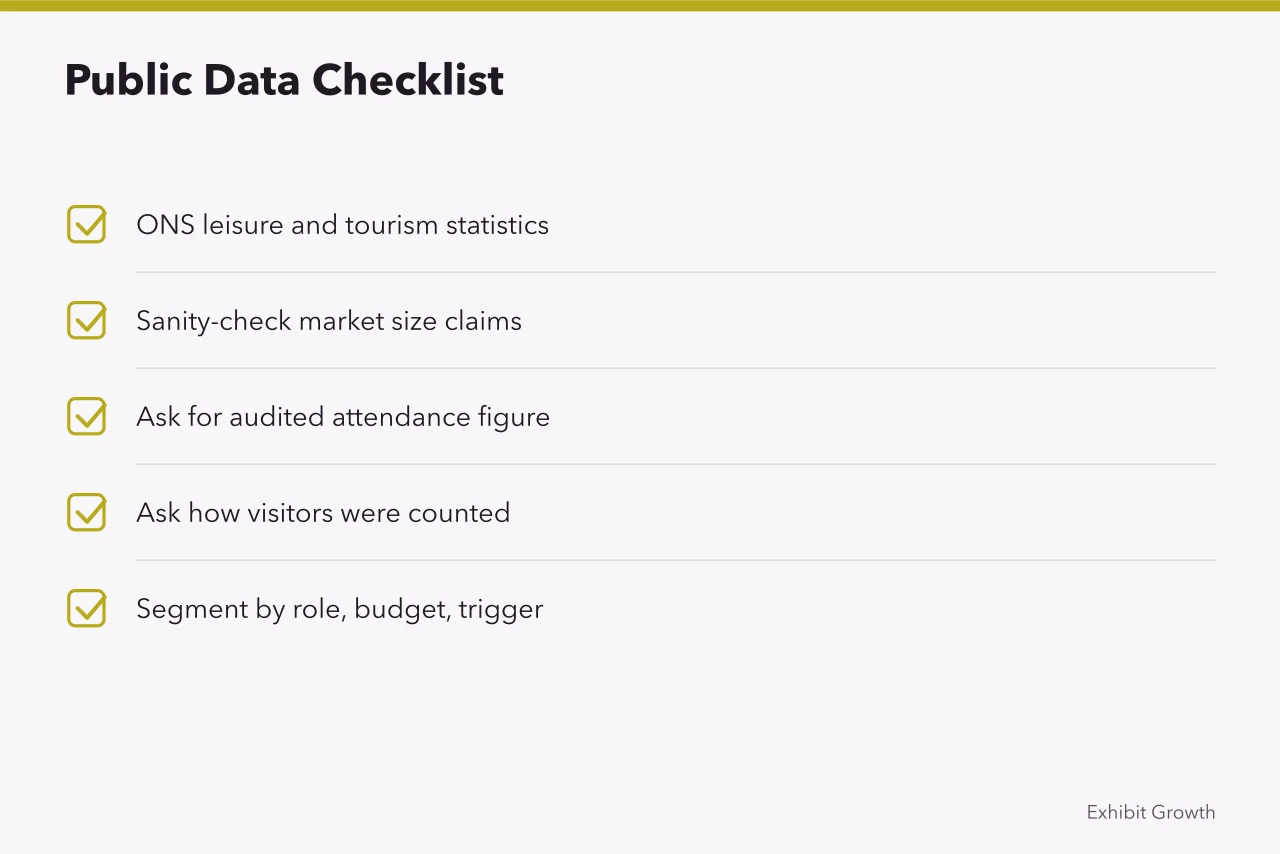
The Office for National Statistics publishes leisure and tourism statistics. The named release to start with is the UK Tourism Satellite Account, which estimates tourism spending in the UK economy and gives you a national baseline. Use it to sanity-check any claim about market size.
National data will not tell you who attends a specific show at a specific venue. It tells you whether the category is growing, flat or shrinking, which is often enough to rule a sector in or out.
Combine that with the organiser's own audit. Ask for the audited attendance figure rather than the marketing number, and ask how visitors were counted. A scanned badge and a footfall estimate are different things.
For a first pass at segmenting that audience by role, budget and buying trigger, the site's guide to trade show marketing target audience in England sets out a workable structure you can fill with your own data.
Interviews before surveys
Surveys are cheap to run and easy to misread. Interviews are slower and far better at telling you what you did not know to ask.
Interview Method
- Run five to eight conversations
- Recruit recent and lapsed buyers
- Include non-buying stand visitors
- Ask what they were solving
- Capture verbatim language
- Stop when themes repeat
Run five to eight conversations before you write a single survey question. Speak to recent buyers, lapsed buyers and people who visited a stand but never bought. Ask what they were trying to solve in the month before the show.
Five questions to open with:
- Walk me through the last trade show you attended. What were you trying to solve in the month before it?
- Who else had a say in whether you went, and what did they want from it?
- What did you do between arriving and leaving?
- What nearly stopped you from registering, visiting a stand or buying?
- How would you describe the problem to a colleague in one sentence?
The site's method for trade show marketing customer interviews covers who to recruit and how to keep the conversation useful rather than polite. The output you want is verbatim language, not ratings.
Record the exact words people use about the problem. Those words become stand headlines, email subject lines and the first line of a sales call.
Stop interviewing when new conversations stop producing new themes. That is a better stopping rule than a target number.
Turning interviews into a survey
Once you have themes, a survey tells you how common each one is. This is where a small sample earns its keep, because you are testing frequency rather than discovering ideas.
Survey Discipline
- Keep it to ten questions
- Ask about the last show
- Ask what stopped them buying
- Report base size with percentages
- Name source and publication date
Keep it short. Ten questions answered honestly beat forty answered carelessly. Ask about the last show they attended, what they came to find, and what stopped them buying.
A ten-question skeleton:
- Which job function best describes your role? (single choice)
- Which of these were you trying to solve in the last six months? (select all that apply, using the themes from your interviews)
- Which one of those is the most urgent? (single choice)
- How do you handle it today? (single choice plus one open box)
- What did you look for first at a stand? (select all that apply)
- Who else signs off the spend? (single choice)
- What budget band applies over the next 12 months? (banded ranges)
- What would stop you buying from a supplier you had not used before? (open)
- How did you hear about the show? (select all that apply)
- May we contact you about the problem you described? (yes or no, plus an email field)
If you need software to field it, the site's comparison of trade show marketing survey tools in England covers the practical choices for small teams, including how to handle exhibition-specific questions.
Report percentages with the base size next to them. A finding from 40 responses is a signal, not a law, and saying so protects your credibility when the number is challenged.
Where you quote a figure in a board paper, name the source and the date it was published. Unattributed numbers tend to be treated as invented, sometimes correctly.
Reading the rules on claims
The Advertising Standards Authority and the Committee of Advertising Practice publish research into advertising issues and their audience impact through their advertising research programme. One named example is the ASA report Depictions, perceptions and harm, on how audiences read gender stereotypes in advertising.
That work is a useful check on how stand graphics and follow-up emails are likely to be read.
Claim Risk vs Recall
Exaggerated claim
- Buyer reaction
- Invites complaint
- Stand graphic
- Overpromises
- Follow-up email
- Risk of ASA action
- Fix
- Test with buyers
Flat claim
- Buyer reaction
- Nobody remembers
- Stand graphic
- Blends in
- Follow-up email
- Ignored
- Fix
- Test with buyers
Exhibition halls are not a regulatory vacuum. A claim on a banner is an advertisement, and the same standards apply as in print or online.
Audience research helps here in a specific way. If you know what your buyers already believe, you can avoid the exaggerated claim that invites a complaint and the flat claim that nobody remembers.
Test headline claims with a handful of target buyers before the artwork goes to print. It is a cheap check against an expensive reprint.
Reaching B2B visitors before the show
If your audience is professional and role-based, paid targeting can put your stand in front of them weeks before the doors open. LinkedIn's audience targeting options for B2B campaigns let you filter by job function, seniority, industry and company size.
Targeted Pre-Show Reach
- Filter by job function and seniority
- Filter by industry and company size
- Invite named segments to a stand feature
- Match message to segment
- Record which segment each visitor came from
Use that to invite named segments to a specific stand feature, not to broadcast a generic invitation. The research tells you which segment cares about which problem.
Match the message to the segment and keep a record of which segment each visitor came from. That record is the beginning of your post-show reporting.
Paid reach does not replace the show's own data. It complements it by reaching people who are deciding whether to attend at all.
Measuring what the research changed
Once the show is over, the question is what actually happened on the stand rather than what the research predicted.
The Data & Marketing Association has published a print campaign case study linking audience insight to measurable results, titled Turning audience insight into measurable results. It is a useful model for connecting a defined audience to a tracked outcome.
Measure What Research Changed
- Decide good result before the event
- Count qualified conversations
- Count samples requested
- Count meetings booked
- Tally on the stand, not from memory
- Compare result with predicted segment
Apply the same discipline to a show. Decide before the event what a good result looks like: qualified conversations, samples requested, meetings booked.
Count those things on the stand, not afterwards from memory. A simple tally sheet beats a retrospective estimate every time.
Then compare the result with the segment you predicted would respond. When the prediction holds, you can repeat it. When it fails, you have learned which assumption to drop.
Personas that survive contact with a stand
A persona is a short, evidence-based description of a buyer that a stand team can act on. It should say what the person is measured on, what they fear and what they need to see before they will talk.
Persona Rules
- Build no more than three
- State what they are measured on
- State what they fear
- State what they must see
- Give a badge or title cue
- Review after every show
Build no more than three. A team of four cannot hold six personas in mind across a two-day show.
The site's guide to trade show marketing buyer personas in England shows how to keep each one tied to interview and survey evidence rather than assumption.
Give each persona a physical cue the stand team can recognise, such as the job title on a badge. Recognition is what turns a document into behaviour.
Review personas after every show. One page of corrections is enough.
Briefing an exhibit supplier
An exhibit company builds what you brief. If the brief says "modern stand, 6x3, backlit logo", you will get exactly that and nothing that reflects your research.
Give the supplier the personas, the three messages that tested best, and the questions the stand team must ask. Ask them to propose a layout that makes those conversations easy.
Where quality marks matter to your buyers, check what the supplier holds. BSI's business innovation audits and certifications explain the standards and certification routes that suppliers can be assessed against.
For event work, the names to ask about are BS ISO 20121 for event sustainability management and ISO 9001 for quality management.
Ask for the same evidence you would give a customer. A supplier who cannot describe their own audience research is unlikely to apply yours well.
For a wider view of what to buy and when to book it, the site's trade show marketing tools and supplier guide covers the supplier categories and lead times that sit around the stand itself.
A decision table for small teams
The table below maps common situations to a sensible method. Use it to choose one approach rather than running everything at once.
Choose
- First show in a new sector
- Desk data plus five buyer interviews
- Two similar shows, one budget
- Audited attendance data and a venue visit
- Existing show, weak leads
- Ten interviews with people who visited and did not buy
- New product launch
- Survey of existing customers plus three persona briefs
- Tight timeline, four weeks out
- Stand team briefing and a short exit survey
- Repeating a successful show
- Last year's tally sheets and a persona review
Avoid
- First show in a new sector
- Commissioning a large survey before you know the questions
- Two similar shows, one budget
- Choosing on stand price alone
- Existing show, weak leads
- Adding more giveaways
- New product launch
- Building the stand before the message is tested
- Tight timeline, four weeks out
- A full research programme
- Repeating a successful show
- Rebuilding the stand from scratch
Budget and timing
Most of the value in audience research comes from time, not money. Interviews cost your own hours. Desk data is free. A survey costs whatever your tool charges.
Survey software is usually charged per user per month. The total depends on the plan tier, the number of users, the response volume you collect and whether you need panel sampling or translated versions. That is why a fixed monthly figure is misleading.
Start eight to twelve weeks before a show if you are interviewing. Start earlier if the finding will change which show you book.
If you have four weeks, skip the survey and brief the stand team properly. A well-briefed team beats an unread report.
Recording sources and assumptions
Keep one page per show with three columns: what we assumed, what we found, what we changed. This is the document that makes next year's decision faster.
Name every external source with its publication date. If a figure came from an organiser, say so and say when they supplied it.
Where a number is illustrative, label it as illustrative in the text. Readers forgive an estimate. They do not forgive an estimate dressed as a fact.
Store the raw interview notes with the summary. Six months later, the verbatim language is more useful than the conclusions.
Common questions
How many people do I need to interview?
Five to eight conversations usually surface the main themes for a single show. Stop when new conversations stop producing new themes rather than when you hit a number.
Can I skip research if I have exhibited for years?
No, but you can do less of it. Review last year's tally sheets, re-interview three lapsed buyers and update the personas. That is a few hours of work.
What is the cheapest useful first step?
Read the organiser's audited attendance data and the ONS leisure and tourism statistics for your sector. Both are free and together they will rule options in or out.
How do I know the research was worth it?
It changed a decision. Name it in the file. If the show, the stand, the message and the staffing all stayed the same, it did not.
In this guide
- Map your trade show marketing target audience before you book a standWork out who your stand is for before you spend on floor space, stand build or giveaways, using your own CRM records, organiser data and a short pre-show survey.
- What trade show marketing buyer persona research means for stand teamsBuyer personas turn stand conversations into evidence you can act on. Build, test and use them for trade show marketing, with a decision table and sources.
- Running trade show marketing customer interviews without leading the witnessPlan trade show marketing customer interviews without leading questions, from recruitment and consent to coding notes into stand decisions, with a worked budget.
- Why trade show marketing survey tools need a privacy check firstTrade show marketing survey tools: named options and a UK privacy check for consent, vendor contracts, retention and reusable wording.
- Seven checks for trade show marketing competitor researchA seven-point checklist for trade show marketing competitor research: what to record, where to look and how to keep claims lawful before you commit stand budget.